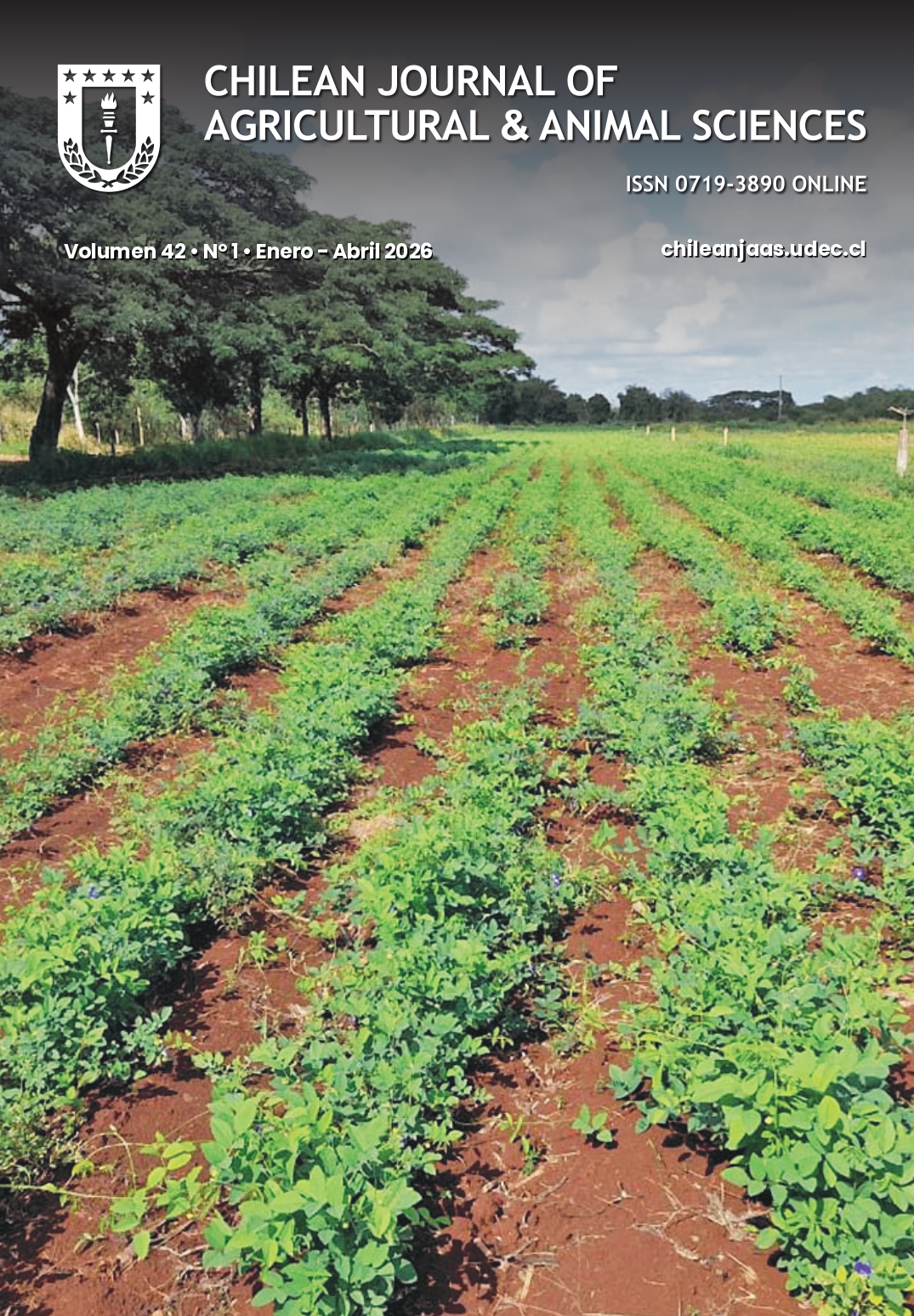
GROWTH AND FORAGE PRODUCTION OF CLITORIA (Clitoria ternatea L.) UNDER TROPICAL CONDITIONS IN MEXICO
DOI:
https://doi.org/10.29393/CHJAAS42-7PRVR60007%20Keywords:
Clitoria ternatea L, cutting height, row spacing, forage productionAbstract
Agronomic management is a crucial factor for optimizing forage legume production under tropical conditions. The objective of this study was to evaluate the effect of row spacing (DS), cutting height (AC), and days after homogenization cut (DDCH) on the growth and forage production of C. ternatea L. The experiment was conducted in Yucatán, Mexico, using a randomized complete block design with a 2 × 2 factorial arrangement, generating four treatments: T1 (5 cm, 80 cm), T2 (10 cm, 80 cm), T3 (5 cm, 60 cm), and T4 (10 cm, 60 cm). Analysis of variance and mean comparison tests (? = 0,05) indicated that DS significantly affected (p<0,01) plant height (AP), intercepted radiation (RI), crop growth rate (TCC), and forage production. In T2, AC modified (p?0,01) AP and RI. AP and RI were greater and showed significant differences (p<0,05) at 88 DDCH in T2, reaching values ??of 110,7 cm and 83%, respectively. TCC was higher at 72 DDCH in T2, reaching a production of 11,6 kg DM ha-1 d-1 (p?0.05). The highest forage production was reached at 80 DDCH (4950 kg ha?¹; p?0.05) in T1. In conclusion, forage production of C. ternatea L. depends on the cutting interval, modulated by row spacing and cutting height, highlighting its productive potential under appropriate agronomic management in tropical conditions in Mexico.
Downloads
Published
How to Cite
Issue
Section
Copyright (c) 2026 Joel Ventura-Ríos, Mario Alberto Santiago-Ortega, Delia Margarita Olvera-Aguilar, Hermes Pérez-Hernández, Perpetuo Álvarez-Vázquez, Adelaido Rafael Rojas-García

This work is licensed under a Creative Commons Attribution 4.0 International License.