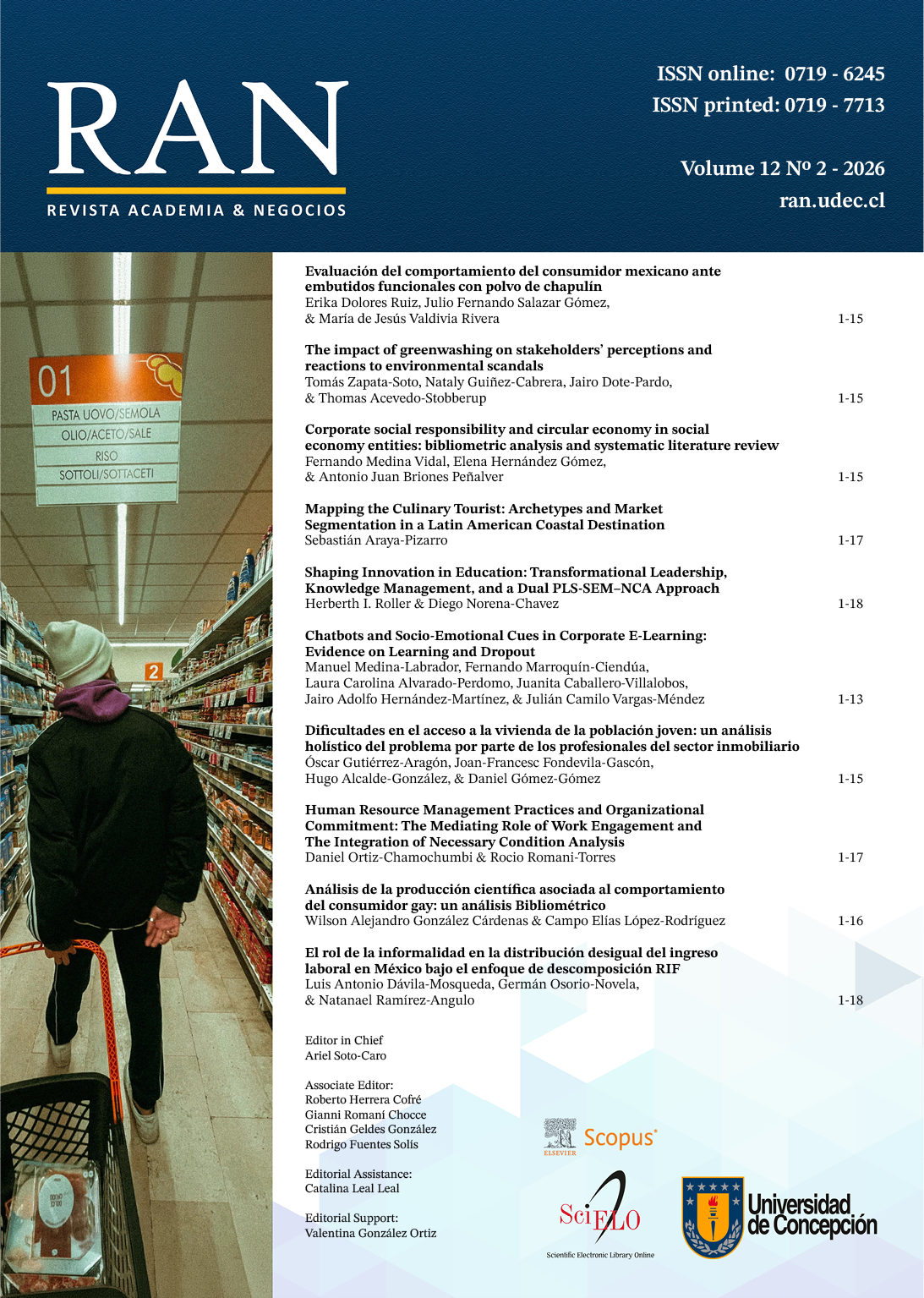
Analysis of the scientific production related to gay consumer behavior: a bibliometric analysis
DOI:
https://doi.org/10.29393/RAN12-20PCGB30020Keywords:
Consumer Behavior, Gay, Bibliometrics, Inclusive Marketing, Sexual MinoritiesAbstract
Purpose: To characterize the evolution of scientific output related to gay consumer behaviour, identifying lines of scholarly development that benefit society, academia, and productive sectors, while integrating the concepts of identity, consumption, and market.
Methodology: Scopus and Web of Science databases were used for a bibliometric analysis of 275 documents published between 1990 and 2025, focused on gay consumer behaviour. The analysis identified citation networks, topic co-occurrence, and conceptual structure.
Findings: The emerging thematic clusters centre on human studies, sexual and gender minorities, and homosexuality. This suggests that the topic has been addressed in a fragmented manner, with limited representation of Latin American realities, often confined to the characterisation of commercial patterns without adequately addressing identity, cultural, and social recognition dynamics.
Implications: The scientific output in this area is responding to the need to understand gay consumers from a comprehensive perspective, through critical and humanistic approaches that enrich the understanding of consumption within this segment.
Originality: An incipient evolution in the field is evident, reflecting both challenges and opportunities for the study of historically excluded populations that may be of interest to businesses. Future research is proposed that integrates inclusive marketing with cultural and identity studies.
Downloads
Published
How to Cite
Issue
Section
Copyright (c) 2026 Wilson Alejandro González Cárdenas, Campo Elías López-Rodríguez

This work is licensed under a Creative Commons Attribution 4.0 International License.